Auraflow — Focus Companion Robot
A pomodoro companion robot that nudges deep-focus users toward scientific breaks.
Project Overview
A companion robot that watches your focus and physically nudges you to rest — a tomato timer with a robotic arm. A brain-computer interface tracks concentration in real time; when focus drops, the arm intervenes (delivering a drink, for example), or a preset timer fires first.
Two trigger modes keep it non-intrusive: a customizable timed reminder, and active intervention the moment focus declines. TuyaOpen's cloud multi-modal AI ties the brain-computer interface, YOLO object detection, and the Lerobot SO100 arm into one system that adapts per user.
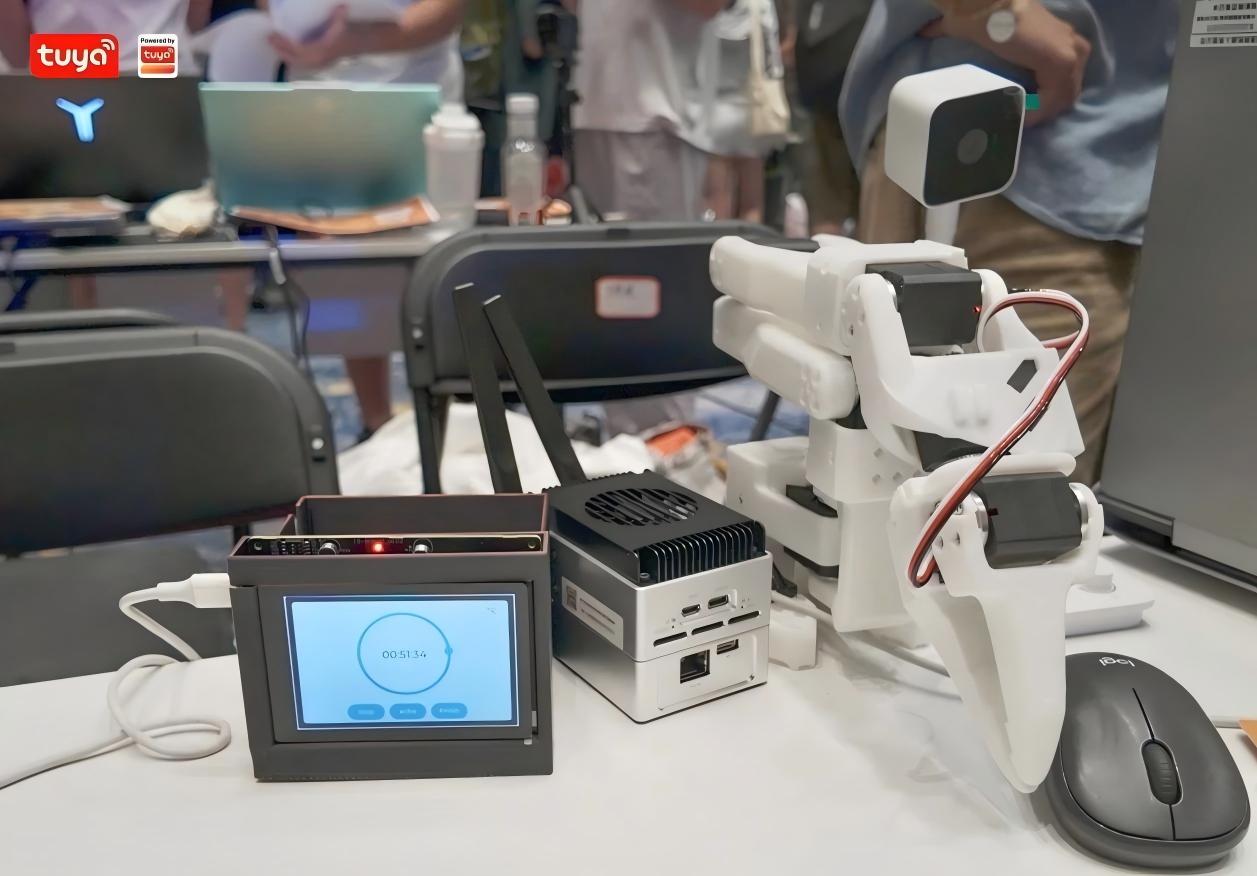
Features
- Tangible guardian (robotic arm physical interaction)
- Precise insight (brain-computer interface real-time monitoring)
- Active intervention (threshold trigger mechanism)
- Empowerment growth (focus training)
- Personalized optimization (adjustable thresholds and duration)
- Small GUI screen for user interaction
- Non-intrusive physical reminders
Technology Stack
- TuyaOpen Framework: Complete AIoT platform enabling seamless integration of complex systems with cloud AI
- Robotics: Robotic arm trajectory planning, Lerobot SO100 setup and control
- AI Processing: Cloud-based YOLO object detection through TuyaOpen
- Interface: Frontend development, brain-computer interface visualization with cloud connectivity
- Hardware: Small GUI screen, robotic arm system with cloud AI integration
- Software: Focus monitoring algorithms, intervention mechanisms powered by cloud AI
Quick Start
- Set up the robotic arm system (Lerobot SO100)
- Configure the brain-computer interface
- Implement YOLO object detection
- Set up the GUI interface
- Configure focus monitoring algorithms
- Set intervention thresholds and timing
- Test the complete system integration
Repository Link
Copyright & License
This project was developed as part of Adventure X 2025 Hangzhou Hackathon. The project and all its components are owned by the participating team members and contest participants. All rights reserved.